
You open the overflowing closet and there it is, a chipped mug that has not held coffee in five years. Beside it sit a single sock with no partner and a stack of tickets from a band you barely remember. Your practical brain says to throw it all out, and your heart quietly says that the mug is part of you.
Psychology explains this through: sentimental attachment, the bond that forms when an object becomes a stand-in for a memory, a person, or a version of yourself.
Consumer researchers have argued for decades that people treat their possessions as part of who they are, which is why those who lose belongings to theft or fire often describe it as losing a piece of themselves.
Madness Meter: 🧠🧠🧠 The Relic Tether (You hold a chipped mug and feel, for a split second, that dropping it in the bin would drop a whole year of your life with it.)
Some clutter stays because you paid for it, the bookkeeping instinct covered in The Great Finish Line Fixation. This clutter stays for a different reason. It was never about the money. It is about what the thing means.
This creates the Relic Tether, the invisible cord that ties an ordinary object to a memory or a piece of your identity, a brain mistaking a mug for a vault.
S³ – Story • Stakes • Surprise
Story | The Mug That Won Again
The Setup: You decide this weekend is the weekend. Trash bags in hand, you pull everything out of the closet, determined to be ruthless.
The Twist: The first thing you pick up is the mug, and suddenly you are back in the apartment where you used it every morning during the hardest, happiest year you had.
The Reading: This is sentimental attachment pulling tight through the Relic Tether. The mug is not valuable. It is a handle on a memory, and your brain does not want to let go of the handle.
The Pattern: Sentimental attachment attaches itself most to objects tied to people, turning points, and versions of you that no longer exist.
Stakes | What the Relic Tether Costs
One mug is harmless, but a home full of sentimental attachment adds up:
The Space Cost. Closets, drawers, and garages fill with things that do nothing except stand guard over old feelings.
The Attention Cost. A cluttered space competes for your focus, so even the objects you never look at still quietly ask for a little of it.
The Future-Self Cost. Keeping every echo of the past can leave no room for the person you are becoming, or for the things that person would use.
The Free-Pass Cost. Calling it all very nice nostalgia lets you skip the honest question of which items still earn their place and which are only habit.
Surprise | The Memory Never Lived in the Mug
Here is the twist that loosens the grip. Sentimental attachment works through the object as a cue, but the memory itself is stored in you. Letting go of the mug does not delete the year. It only removes one of many triggers, and you can keep the story without keeping the shelf space.
The Cure: Honor the memory and release the object:
- Feel It First: When the pang hits, name it. This is a strong memory. Do not rush past the feeling.
- Keep the Story, Not the Stuff: Take a photo of the object and write two lines about why it mattered. The story survives without the shelf.
- Pick One Keeper per Memory: If five items point to the same year, choose the single best one and let the rest go.
- Use the Contemplation Box: Put unsure items in a dated box. If you have not missed anything in it after six months, you have your answer.
A² – Apply • Amplify
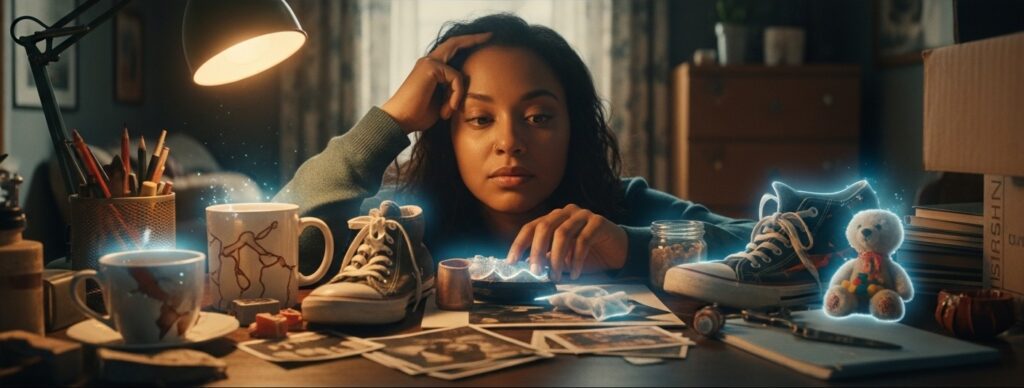
Sentimental attachment is a well-studied part of how people relate to their belongings, and it is a normal, mostly healthy one. The research helps explain where it comes from and when it becomes a problem.
The Psychology Bits
- Objects Extend the Self: A classic idea in consumer research holds that we treat possessions as part of our identity, which is the root of sentimental attachment, so losing one can feel like losing part of ourselves.
- Some Things Feel More Like Me: Researchers have described how people sort possessions into “me” and “not me,” with the strongest sentimental attachment going to the things that carry personal history.
- Normal Is Not the Same as a Disorder: Strong attachment to a few objects is ordinary. Clinical hoarding involves intense distress about discarding and clutter that keeps rooms from being used.
- It’s a Specific Case of a Bigger Pattern: Parting with things hurts more than getting equal things pleases, the loss pattern in The ‘Ghost-in-the-Wallet’ Brain. That one is about money and risk. This one is about meaning, memory, and who you were.
Applying the Relic Tether Habit
Make decluttering a gentle habit that respects your sentimental attachment instead of a yearly battle:
- Name the Tether: When you hesitate over an object, say “Relic Tether” and notice the memory it is pulling on.
- Ask the Present-Self Question: Does this serve the person I am now, or only the person I was? Answer honestly.
- Work in Short Bursts: Fifteen minutes on one drawer beats a whole weekend of draining decisions.
- Pass It On: Give the item to someone who will use it and tell them its story. It stays loved without staying in your closet.
FAQ
Q | Is sentimental attachment unhealthy? A | No. Valuing meaningful objects is normal and often comforting. It becomes a problem only when it causes distress or clutter that gets in the way of daily life.
Q | Why does an object feel like a memory? A | Objects work as cues. Seeing or touching one can bring a whole scene back, so throwing it out can feel like throwing out the scene.
Q | Will I forget if I let it go? A | Usually not. The memory is stored in you, and a photo plus a few written lines can keep the details alive.
Q | Is this the same as hoarding disorder? A | No. Hoarding disorder is a clinical condition marked by strong distress about discarding and living spaces that cannot be used as intended. Ordinary sentimental attachment is far milder.
Q | How many keepsakes are too many? A | There is no magic number. A useful test is whether you can still use your space, find things, and feel calm about your belongings.
Q | What if a keepsake belonged to someone I lost? A | Go slowly. Keep what brings comfort, photograph the rest, and give yourself permission to decide in your own time.
Citations & Caveats
- Source 1: Belk, R. W. (1988). Possessions and the Extended Self. Journal of Consumer Research, 15(2), 139-168.
- Source 2: Kleine, S. S., Kleine, R. E., III, & Allen, C. T. (1995). How Is a Possession “Me” or “Not Me”? Characterizing Types and an Antecedent of Material Possession Attachment. Journal of Consumer Research, 22(3), 327-343.
- Source 3: Steketee, G., & Frost, R. O. (2003). Compulsive Hoarding | Current Status of the Research. Clinical Psychology Review, 23, 905-927.
Disclaimer: This article is for informational purposes only and is not a substitute for professional psychological advice. Sentimental attachment to objects is normal. If distress about discarding items, or clutter that blocks your living space, is affecting your daily life, consider speaking with a qualified mental health professional.
// Protocol · Next Transmission
The glitch is the signal. — Psyness Protocol