
You see a sleeping puppy curl its tiny paw and something in your chest clenches. Your hands ball into fists. Your teeth find themselves wanting to gently clamp down on something. A small, urgent voice says I could just eat this thing whole. You are not a monster. You are not secretly dangerous. You are experiencing Cute Aggression, and your brain has a very specific, very documented reason for doing this to you.
Psychology explains this through: Cute Aggression, the involuntary urge to squeeze, pinch, or gently bite something you find overwhelmingly adorable, a well-studied quirk of how your brain handles emotional overload, not a warning sign about your character.
Researchers testing this exact reaction had people pop bubble wrap while viewing slideshows of cute animals, funny animals, or neutral animals, telling them to pop as many or as few bubbles as they liked. The cute-animal group popped significantly more bubbles than the other two, a measurable, physical stand-in for an urge with nowhere else to go.
Madness Meter: 🧠🧠🧠 The Squish Reflex (You’ve whispered “I will end you” to a sleeping kitten, in a voice you have never once used for an actual threat.)
Cute Aggression is one specific way your brain handles a feeling that’s gotten too big too fast. A more general version of that same overload, where the feeling gets dodged entirely instead of discharged, is covered in The ‘Too-Much-To-Feel’ Brain. That one is your brain avoiding a feeling that’s too intense to sit with. This one is your brain acting on a feeling that’s too intense to just sit with either, just in the opposite direction.
This creates the Squish Reflex, a paradoxical burst of mock-aggression that shows up precisely when affection becomes too intense to express any other way.
S³ – Story • Stakes • Surprise

Story | The Puppy Video That Nearly Ruined a Work Call
The Setup: A coworker shares their screen for one second too long and a video of their new puppy tripping over its own ears is suddenly playing for the whole meeting.
The Twist: Instead of saying “aww,” you catch yourself making a strange, strangled noise and gripping the edge of the desk, fighting a genuine urge to reach through the screen and squeeze something that isn’t even in the room.
The Reading: This isn’t a lapse in professionalism, it’s the Squish Reflex doing exactly what it’s built to do, converting an emotional overload into a small, harmless burst of mock-aggression because the affection alone is too much to just hold.
The Pattern: It shows up hardest in the first half-second of seeing something extremely cute, right before your face has even settled on an expression, which is exactly when the emotional spike is at its highest.
Stakes | What the Squish Reflex Costs
A Squish Reflex is usually harmless, occasionally awkward:
The Social Cost. Blurting out “I could just crush you” about someone’s actual baby tends to need a quick follow-up sentence of clarification.
The Misread Cost. Because the urge arrives dressed as aggression, people unfamiliar with Cute Aggression sometimes genuinely worry something is wrong with them, when the reaction is actually close to universal.
The Suppression Cost. Fighting the urge to express it at all, rather than finding a small harmless outlet, can leave the original surge of affection with nowhere to go and no way to settle.
The Free-Pass Cost. Writing the whole thing off as a very nice, purely funny reflex skips past how real the underlying mechanism is, your brain actively working to keep one emotion from overwhelming your ability to function.
Surprise | The Reflex Is Protecting the Feeling, Not Attacking It
There’s nothing to cure here exactly, a Squish Reflex isn’t a flaw in your personality. It’s your brain’s way of keeping one enormous feeling from short-circuiting your ability to actually respond to what’s in front of you.
The Cure: Work with it instead of fighting it:
- Name It Out Loud: Saying “Cute Aggression” the moment you feel it turns a confusing jolt into a recognized, harmless pattern.
- Give It a Small Outlet: Squeeze a pillow, clench a fist, or make the funny noise. The urge is looking for a release valve, not a victim.
- Expect the First-Second Spike: Knowing the urge is strongest in the instant you first see the cute thing makes it easier to ride out rather than panic about.
- Let Other People Have Theirs: If someone else blurts out something aggressive-sounding about your baby or your dog, assume Cute Aggression before assuming anything else.
A² – Apply • Amplify
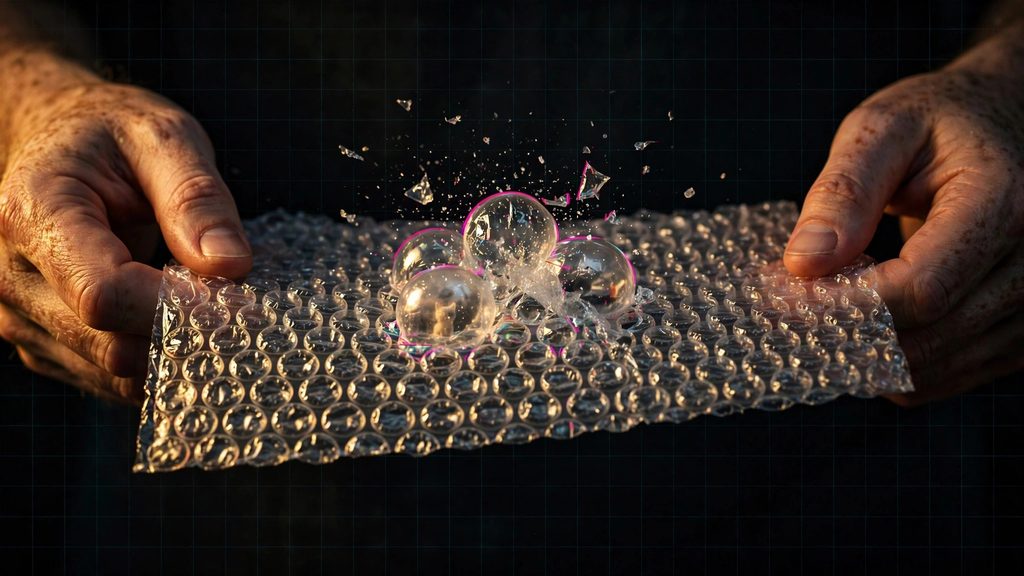
Cute Aggression is a documented, well-studied piece of how your brain regulates overwhelming positive emotion, not evidence of a dark side hiding underneath the nice one.
The Psychology Bits
- The Term Comes From an Actual Study: Researchers coined “dimorphous expression” to describe emotional reactions that show up looking like their opposite, Cute Aggression being the clearest everyday example, happy tears being another.
- Your Brain Reacts Fast, on Purpose: Brain-wave studies recording people’s responses to cute images found rapid activity in both the brain’s reward circuitry and its emotion-processing regions within a fraction of a second, evidence the overload is real, not performed.
- It’s a Specific Case of a Much Older Pattern: The features that trigger it at all, big eyes, a round face, a small body, were first described as the baby schema, a set of cues evolution wired adult brains to answer with intense caretaking urges, the exact response Cute Aggression helps regulate.
- The Internet Didn’t Invent It, It Just Industrialized It: A lighter, meme-driven version of this same urge to do something with an overwhelming feeling shows up in The ‘Reaction GIF’ Brain. That one is reaching for a meme because the feeling is too big to type out. This one is reaching for an urge to squeeze because the feeling is too big to just hold.
Applying the Squish Reflex Habit
Turn a confusing jolt into something you actually understand:
- Catch the First Second: Notice the exact moment the urge spikes, usually right as you first see the cute thing, before any thought has caught up.
- Translate the Urge: Mentally relabel “I want to crush this” as “I am feeling an enormous amount of affection and my brain needs somewhere to put it.”
- Use a Real Outlet: Keep the response physical but harmless, a clenched fist, a squeezed pillow, an exaggerated noise, instead of suppressing it entirely.
- Normalize It for Others: Mention Cute Aggression by name next time someone apologizes for wanting to “just eat” your dog. It helps more than it sounds.
FAQ
Q | Is Cute Aggression a sign something is wrong with me? A | No. It’s a well-documented, nearly universal reaction, not a symptom of anything concerning.
Q | Does Cute Aggression mean I secretly want to hurt the cute thing? A | No. Studies on the reaction consistently find no actual intent to harm, only the urge, which functions as a release valve, not a plan.
Q | Why does it happen with babies and animals specifically? A | Both tend to share baby schema features, big eyes, round faces, small bodies, that reliably trigger an intense caretaking response, the exact response Cute Aggression helps regulate.
Q | Is this the same thing as crying at happy news? A | They’re close relatives. Both are dimorphous expressions, emotional reactions that show up looking like their opposite because the original feeling is too intense to express directly.
Q | How is this different from The ‘Too-Much-To-Feel’ Brain? A | That one covers a brain avoiding an overwhelming feeling altogether. This one covers Cute Aggression, a brain acting on an overwhelming feeling instead, through a paradoxical, harmless outlet.
Q | What should I actually do when I feel it? A | Give it somewhere harmless to go, a squeezed pillow, a clenched fist, a funny noise, rather than suppressing it or worrying about it.
Citations & Caveats
- Source 1: Aragón, O. R., Clark, M. S., Dyer, R. L., & Bargh, J. A. (2015). Dimorphous Expressions of Positive Emotion | Displays of Both Care and Aggression in Response to Cute Stimuli. Psychological Science, 26(3), 259-273.
- Source 2: Stavropoulos, K. K. M., & Alba, L. A. (2018). It’s So Cute I Could Crush It | Understanding Neural Mechanisms of Cute Aggression. Frontiers in Behavioral Neuroscience, 12, Article 300.
- Source 3: Lorenz, K. (1943). Die Angeborenen Formen Möglicher Erfahrung (Innate Forms of Potential Experience). Zeitschrift für Tierpsychologie, 5, 235-409.
Disclaimer: This article is for informational purposes only and is not a substitute for professional psychological advice. Cute Aggression is a normal, well-documented emotional response. If you experience urges toward actual harm rather than this harmless paradoxical reflex, that’s worth discussing with a qualified professional.
// Protocol · Next Transmission
The glitch is the signal. — Psyness Protocol