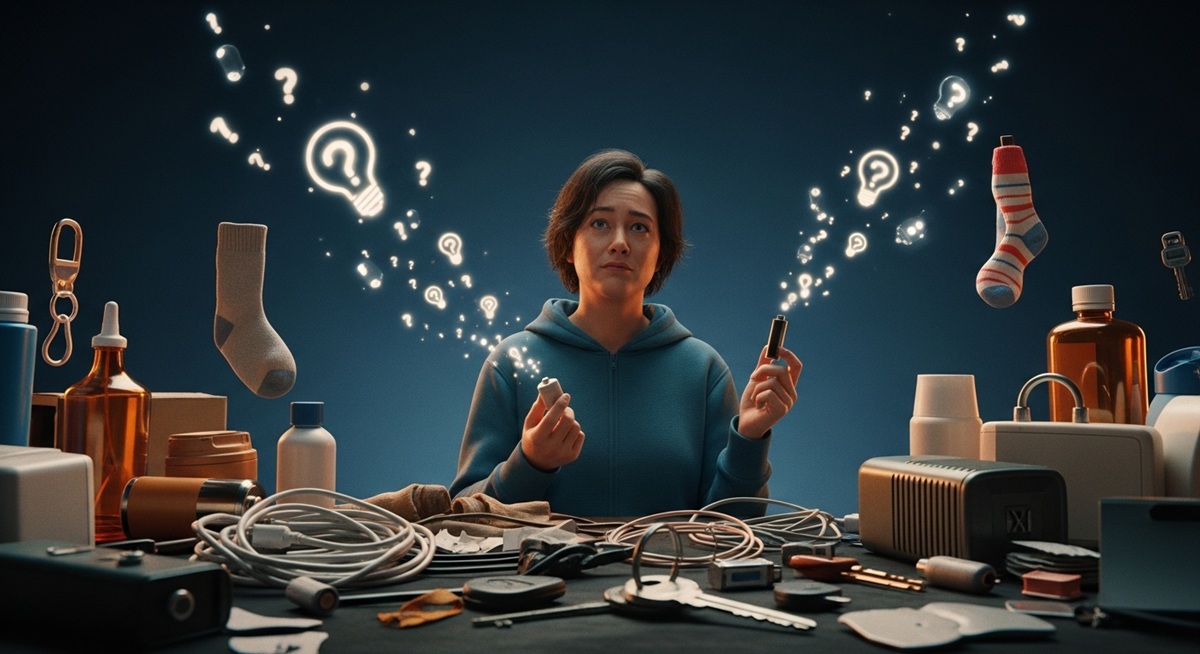
The ‘just in case’ hoard is the habit of keeping things you do not need now because you can imagine a future where you might. You open the drawer and find a charging cable for a phone you no longer own, a dried-up pen, three orphaned buttons, and a key to nothing you can name. You know you do not need them. Then a small voice asks, “But what if?”
Psychology explains this through: loss aversion, the finding that giving something up tends to hurt more than getting the same thing feels good, and the endowment effect it helps produce.
In classic experiments, people who were handed a mug asked for roughly twice as much to sell it as others were willing to pay to get one, which suggests that simply owning something raises its felt value.
Madness Meter: 🧠🧠🧠 The Maybe Ledger (Your brain keeps a running tab of every improbable future need and never audits it.)
It is the object-shelf cousin of The ‘Ghost-in-the-Wallet’ Brain. That one explains why a loss stings so sharply with money. This one shows the same sting at work in your junk drawer.
This creates the Maybe Ledger, the way loss aversion books every discarded item as a possible future regret while keeping it is booked as free.
S³ – Story • Stakes • Surprise
Story | The Mug Experiment
The Setup: Kahneman, Knetsch, and Thaler gave some students a coffee mug and left others without one, then let both groups trade in a simulated market.
The Twist: Owners demanded far more to give up the mug than non-owners would pay for it, so far fewer trades happened than standard theory predicts. The authors tied this to loss aversion, because parting with the mug was coded as a loss.
The Reading: This is the Maybe Ledger at work. Once something is yours, letting it go counts as a loss, and your brain weighs that loss more heavily than the matching gain of free space.
The Pattern: Loss aversion gets louder for items you could imagine needing, which is why a spare cable feels harder to bin than a spare napkin.
Stakes | What the Maybe Ledger Costs
Letting loss aversion run unchecked can quietly cost you:
The Space Cost. Every kept item takes up room, and a full drawer makes the one thing you actually need harder to find.
The Attention Cost. Stuff you own asks to be moved, sorted, and worried about, and that background load adds up.
The Duplicate Cost. When you cannot find the thing you kept, you buy another, which is the opposite of the preparedness you were after.
The Free-Pass Cost. Calling it a very nice sensible habit can stop you from asking whether the thing has earned its shelf.
Surprise | Scarcity Is Not the Driver
Here is the twist about the ‘just in case’ hoard. It is natural to assume it comes from money worries, but in Frost and Gross’s study of people who save excessively, the saving was not linked to economic hardship. What did show up was indecisiveness and anxiety about making a mistake, with hoarders often buying duplicates as insurance against need. In other words, the ledger is less about poverty and more about avoiding the discomfort of a possibly wrong decision. Loss aversion plays out here as a fear of mistakes more than a fear of poverty. That is good news, because a decision rule is easier to change than a bank balance.
The Cure: Audit the Ledger and your loss aversion with a decision rule instead of a mood:
- Price the Regret: Ask how likely you are to need it, and how easily you could borrow or replace it if you did.
- Set a Use-By Test: If you have not touched it in a year, treat that as a rule of thumb that you probably will not, and make it earn an exception.
- Start With One Drawer: Clear a single small area so you collect a real win and learn that letting go is survivable.
- Run One In, One Out: When something new arrives, send something similar on its way.
A² – Apply • Amplify

The brain is not hoarding because it is foolish. It is hoarding because loss aversion makes a possible loss feel louder than a certain clutter.
The Psychology Bits
- Loss Aversion Is Measured: Kahneman and Tversky’s prospect theory describes how losses loom larger than equivalent gains, which is the engine behind most ‘what if I need it’ thinking.
- Ownership Raises Value: In the mug studies, owners valued the same object more than people who did not own it, which is the endowment effect.
- Sunk Cost Plays a Part: Arkes and Blumer showed that people keep using what they paid for to avoid feeling the money was wasted, and that same pull can make you hold on to a purchase you never use.
- It’s a Specific Case of a Bigger Pattern: The preference for keeping what you have is the clutter version of the pattern explained in The ‘Better the Devil You Know’ Brain. That one is about why staying put feels safe. This one is about why keeping stuff does.
Applying the Loss Aversion Habit
Treat loss aversion as a bias to audit, not a command to obey:
- Reframe the Loss: When you hesitate, name what you gain by letting go, such as space, time, or a clear drawer.
- Imagine Buying It Today: Ask whether you would pay for the item now at its current usefulness, and if not, that is a sign the ownership glow is doing the talking.
- Make a Maybe Box: Put uncertain items in a box with a date, and discard the box unopened if nothing is needed by then.
- Keep the Real Backups: Hold on to genuine essentials such as important documents and safety items, and be generous about releasing the rest.
FAQ
Q | Does keeping extra things mean I have hoarding disorder? A | No. Keeping a few spares is very common. Hoarding disorder is a distinct clinical condition marked by persistent difficulty parting with possessions and significant distress or impairment.
Q | Is the ‘just in case’ habit really about fear of scarcity? A | Not necessarily. In one study of people who save excessively, hoarding was not linked to economic hardship, and indecisiveness and fear of mistakes stood out instead.
Q | What is the endowment effect? A | It is the tendency to value something more once you own it, which was shown when mug owners asked for more to sell than others would pay to buy.
Q | Why does throwing something away feel worse than it should? A | Loss aversion makes giving something up feel more painful than gaining its equivalent, so a discard is weighed as a loss even when the item is useless.
Q | Is the one-year rule backed by research? A | It is a practical rule of thumb rather than a research finding, so treat it as a prompt to ask whether the item has earned its place.
Q | When should I seek help? A | If clutter blocks living spaces, causes distress, strains relationships, or you cannot discard things despite wanting to, a qualified mental health professional can help.
Citations & Caveats
- Source 1: Kahneman, D., Knetsch, J. L., & Thaler, R. H. (1990). Experimental tests of the endowment effect and the Coase theorem. Journal of Political Economy, 98(6), 1325-1348.
- Source 2: Frost, R. O., & Gross, R. C. (1993). The hoarding of possessions. Behaviour Research and Therapy, 31(4), 367-381.
- Source 3: Arkes, H. R., & Blumer, C. (1985). The psychology of sunk cost. Organizational Behavior and Human Decision Processes, 35(1), 124-140.
Disclaimer: This article is for informational purposes only and is not a substitute for professional psychological advice. Keeping the occasional spare is a normal human habit, not a diagnosis. If clutter is affecting your well-being, safety, or relationships, please speak with a qualified mental health professional.
// Protocol · Next Transmission
The glitch is the signal. — Psyness Protocol