
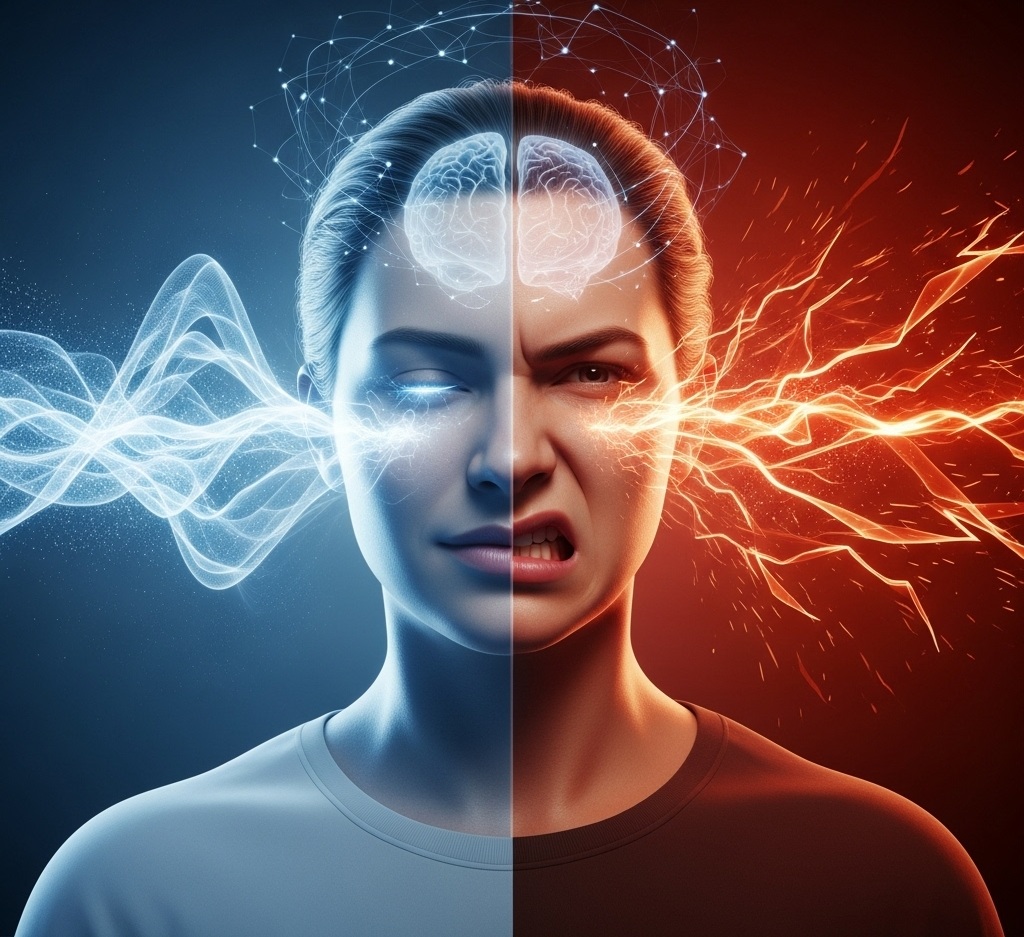
A soft whisper starts, and a warm tingle slides from your scalp down your spine. Ten minutes later someone chews with their mouth open, and the same ears that just felt bliss now want to flee the room. Same brain, same volume, opposite verdicts.
Psychology explains this through: auditory triggers, sounds that set off strong, involuntary body and emotion responses, with ASMR at the pleasant end and misophonia at the painful end.
In a survey of people who experience ASMR, whispering was the most common trigger, followed by personal attention, crisp sounds, and slow movements.
Madness Meter: 🧠🧠🧠 The Sound Switch (One tiny noise flips you into bliss or battle mode before you have decided anything.)
It is the sound-shaped cousin of The ‘I Just Can’t Relax!’ Brain. That one is about a body that cannot unwind. This one is about the sounds that switch unwinding on or off.
This creates the Sound Switch, the way a single everyday noise can flip your body into calm or alarm, depending on how your brain tags it.
S³ – Story • Stakes • Surprise
Story | One Brain, Two Reactions
The Setup: You press play on a video of someone tapping softly and whispering, and your shoulders drop.
The Twist: A few hours later a colleague sniffs, clicks a pen, or chews loudly, and your heart pounds with irritation or even rage.
The Reading: This is the Sound Switch. Auditory triggers are not about volume. They are about what your brain assigns to a particular sound, so the same ears can deliver bliss and dread.
The Pattern: Pleasant auditory triggers tend to be soft and slow, while painful ones tend to be repetitive sounds made by other people, often someone close by.
Stakes | What the Sound Switch Costs
Strong auditory triggers can quietly cost you:
The Focus Cost. A trigger sound can hijack attention, so a quiet office or a shared meal becomes hard to endure.
The Relationship Cost. People may avoid shared meals, or snap at family over sounds they cannot help making.
The Shame Cost. Many people hide their reactions because they fear sounding petty, which makes the distress worse.
The Free-Pass Cost. Calling it a very nice quirk can delay getting help when a trigger is seriously disrupting daily life.
Surprise | Calm and Arousal Can Arrive Together
Here is the twist about auditory triggers. ASMR is not simple relaxation. In one study, people who experience ASMR showed a lower heart rate while watching ASMR videos, yet their skin conductance rose, a sign of arousal. In other words, the body can feel calm and alert at the same moment. Misophonia, at the other end, has been linked to exaggerated responses in the anterior insula, a region that tags sensations as important, and to unusual connections with emotional areas. The sound is not the problem. The importance your brain assigns to it is.
The Cure: Work with your Sound Switch instead of fighting it:
- Map Your Triggers: Keep a short list of the sounds that soothe you and the ones that set you off.
- Curate the Soundscape: Seek out soothing sounds when you need to relax, and use headphones or white noise to soften the painful ones.
- Ask Kindly: Tell people close to you which sounds are hard for you and suggest a simple fix, such as a different seat.
- Redirect Gently: When a trigger hits, name it, take a slow breath, and move your attention to something steady.
A² – Apply • Amplify

Auditory triggers are individual, and the research on auditory triggers is still young, but it already shows that the body responds before the thinking mind weighs in.
The Psychology Bits
- ASMR Mixes Calm and Arousal: In a study of 110 people, those with ASMR showed reduced heart rate and increased skin conductance while watching ASMR videos, compared with matched controls.
- Triggers Are Specific: In an early survey, whispering, personal attention, crisp sounds, and slow movements were the most common ASMR triggers, while sounds like a vacuum cleaner rarely worked.
- Misophonia Involves Salience: Brain imaging showed exaggerated responses in the anterior insula and altered connections with the vmPFC, hippocampus, and amygdala when people with misophonia heard trigger sounds.
- It’s a Specific Case of a Bigger Pattern: Locking onto one tiny detail while missing the rest is the habit in The ‘Magnifying Glass’ Brain. That one is about visual and mental details. This one is about a single sound you cannot ignore.
Applying the Auditory Triggers Habit
Use what you know about your auditory triggers:
- Build a Calm Playlist: Save a few soothing sounds, such as soft tapping, rain, or quiet music, for stressful moments.
- Carry an Escape Tool: Keep earbuds or a small noise source with you for unavoidable trigger sounds.
- Give Meals a Plan: If a family meal is hard, add background music or sit where you hear less.
- Track the Pattern: Note when triggers feel worse, such as when you are tired or stressed, and plan around those times.
FAQ
Q | Is ASMR real? A | Yes. Studies show that people who experience it report reliable calm and show measurable changes in heart rate and skin conductance, though not everyone experiences it.
Q | What is misophonia? A | It is a strong negative reaction, such as anger, anxiety, or disgust, to specific sounds like chewing or sniffing, and brain imaging suggests the brain assigns these sounds unusual importance.
Q | Are ASMR and misophonia related? A | They both involve strong reactions to specific sounds, but they feel opposite and are different experiences, and one does not cause the other.
Q | Why do some sounds bother me and not others? A | Researchers think the brain assigns extra importance to certain sounds, and learned associations can also shape which ones bother you.
Q | Can I reduce my reaction to trigger sounds? A | Many people find that earbuds, white noise, and planning around auditory triggers help, and a professional can offer further strategies.
Q | When should I seek help? A | If trigger sounds cause intense distress, affect your work or relationships, or make you avoid everyday situations, an audiologist or mental health professional can help.
Citations & Caveats
- Source 1: Barratt, E. L., & Davis, N. J. (2015). Autonomous Sensory Meridian Response (ASMR) | A flow-like mental state. PeerJ, 3, e851.
- Source 2: Poerio, G. L., Blakey, E., Hostler, T. J., & Veltri, T. (2018). More than a feeling | Autonomous sensory meridian response (ASMR) is characterized by reliable changes in affect and physiology. PLoS ONE, 13(6), e0196645.
- Source 3: Kumar, S., Tansley-Hancock, O., Sedley, W., Winston, J. S., Callaghan, M. F., Allen, M., Cope, T. E., Gander, P. E., Bamiou, D. E., & Griffiths, T. D. (2017). The brain basis for misophonia. Current Biology, 27(4), 527-533.
Disclaimer: This article is for informational purposes only and is not a substitute for professional medical or psychological advice. Auditory triggers vary widely, and misophonia is not yet a formal diagnosis in major manuals. If sounds are causing you significant distress, please speak with a qualified professional.
// Protocol · Next Transmission
The glitch is the signal. — Psyness Protocol