Your morning wardrobe battle? It’s enclothed cognition! Your brain uses clothes as social shorthand, mood magic, and an ego shield. Discover which iconic movie character’s style you secretly embody, and why your sartorial choices are a very nice psychological plot twist.
Psychology explains this through: self-perception, social signaling, and the powerful link between attire and mental state.
Your dressing style isn’t just fabric; it’s your brain’s daily performance art.
Spotting it means realizing your clothes are silently telling your story.
Madness Meter: 🌀🌀 Medium (You’ll never look at a blazer the same way again!)
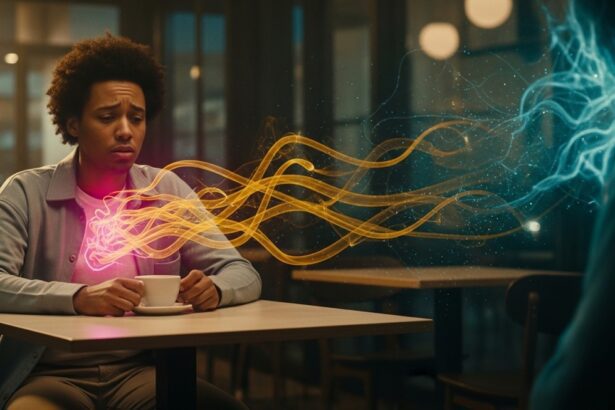
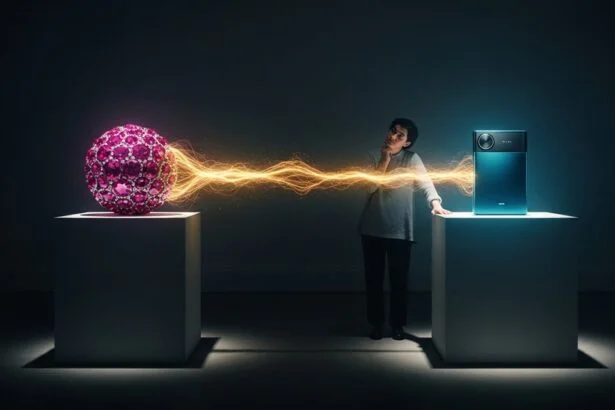
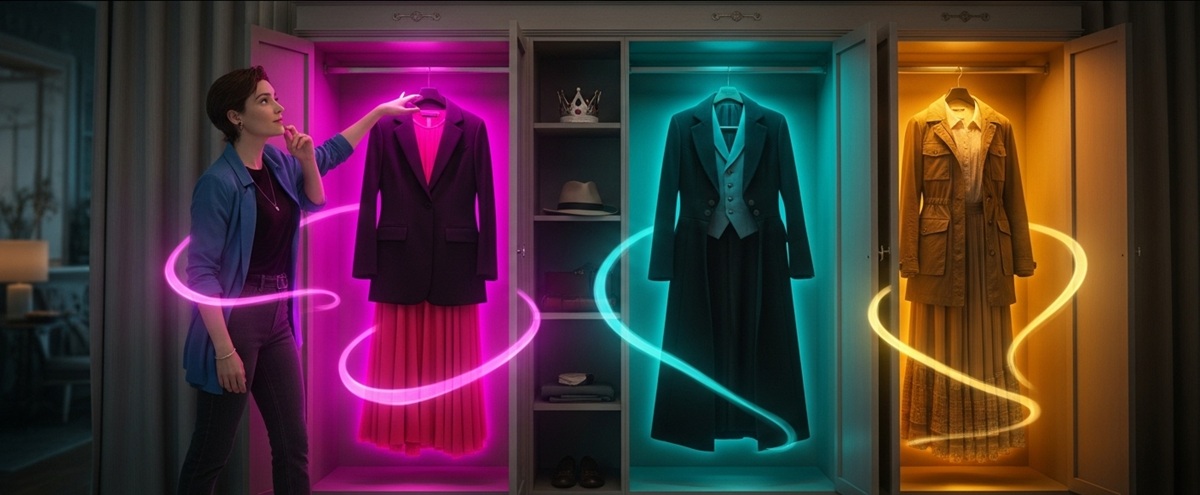
You’re standing before the wardrobe, engaged in the daily negotiation with your better self. “Shall we dress like a competent adult or a chaotic raccoon who’s stolen a discount cardigan?” Clothing, your magnificent brain knows, is theatre you can wear to the office. It’s social shorthand, mood regulation, and—crucially—an opportunity to say “I’m fine” with a blazer so sharp it could julienne a cucumber. Fashion psychologists call this phenomenon enclothed cognition; the rest of us call it “putting on something that makes the day behave.” This peculiar ritual highlights a fascinating paradox | your wardrobe isn’t just about covering up; it’s a powerful psychological tool, a silent language, and a very nice, beautifully unhinged “costume drama” your brain orchestrates every single day. Is your mind simply making fashion choices? Or is your beautiful brain merely doing its very nice, very efficient (though profoundly subconscious) job of influencing how you think, feel, and act? At Psyness.com, we take a “very nice!” look at this peculiar psyche, proving that understanding this peculiar psyche doesn’t have to be boring – it can be a riot.
There’s a moment each morning when you stand before the wardrobe and negotiate with your better self. Shall we dress like a competent adult or a chaotic raccoon who’s stolen a discount cardigan? Clothing is theatre you can wear to the office. It’s social shorthand, mood regulation, and—crucially—an opportunity to say “I’m fine” with a blazer so sharp it could julienne a cucumber. Fashion psychologists call it enclothed cognition; the rest of us call it “putting on something that makes the day behave.” Your wardrobe isn’t just fabric; it’s your brain’s daily performance art, a psychological playbook influencing how you feel and how others perceive you. Below, we translate six unmistakable movie characters into living, wearable personalities. You may recognise yourself in one; you may recognise your ex in all six. Either way, by the end you’ll have a clearer sense of why your hand keeps drifting toward black trousers (again) or why your heart insists on sequins at lunchtime (also again). And yes, there’s a cheeky quiz at the end with answers—because you deserve closure.
The Characters We Secretly Dress As
If your wardrobe is 80% structure, 20% withering glance, you are very likely Miranda Priestly (The Devil Wears Prada). You believe tailoring is a human right and that a good coat can fix most policy problems. Your palette | ink, charcoal, oxblood. Your natural habitat | a meeting that was meant to be an email. Your brain uses enclothed cognition to project authority and competence, subtly shifting your posture and mindset. Add a sculpted blazer to anything—T-shirt, hoodie, existential dread—and watch your posture improve by two vertebrae. Your fuchsia-pink power dressing signals dominance and control, making the world (and yourself) take you more seriously.
If your outfits radiate sunshine even on a Tuesday in February, say hello to Elle Woods (Legally Blonde). You weaponise joy. You understand that pink isn’t a colour; it’s a thesis statement. There’s rigour beneath the ribbons—precise fits, polished fabrics, “I will destroy you politely” energy. You’re proof that dopamine dressing boosts not just mood but also results, leveraging the psychological power of color and meticulous presentation. You pass the vibe check and the bar. Your deep teal/cyan wardrobe choices reflect optimism and a strategic use of femininity to disarm and succeed.
If your closet looks like a vintage market fell in love with a road trip, you’re Penny Lane (Almost Famous). Fringes, floaty midi skirts, stories in the seams. Your jewellery has context and your scarves have seen things. You dress like you collect moonlight. People tell you their secrets on trains. You own at least one pair of boots that have been to three countries and one questionable gig. Your brain uses clothing to express a romantic sensibility and a connection to stories, history, and free-spirited adventure. Your cheerful mustard yellow bohemian flair invites connection and shared narrative.
If you think pockets are a human right and heels are a structural hazard, meet Lara Croft (Tomb Raider). Utility jackets, cargo trousers, boots you could outrun a dinosaur in—you are the child of function and ferocity. Your bag is cross-body because your hands are for doing things, like saving the group chat from poor decisions. You don’t wear accessories; you carry equipment. Your brain prioritizes utility and readiness, using clothing to signal capability and a no-nonsense approach to the world. Your fuchsia-pink tactical style speaks of adventure and practical power.
If your colour scheme is “night” and your silhouette says “try me,” you’re Trinity (The Matrix). Long coats, slick fabrics, sunglasses indoors if we’re being honest. You find serenity in monochrome. The absence of colour is not the absence of personality; it’s a refusal to be distracted, a statement of focus and unwavering purpose. Your look is an app that closes all background tabs in your brain. Your deep teal/cyan minimalist wardrobe reflects a desire for psychological clarity and a formidable, no-frills identity.
And if your aesthetic is “stole it from a poet and made it better,” you’re Jo March (Little Women). Soft waistcoats, boyish shirts, clever trousers, sensible boots. You can out-argue a philosopher while mending a hem. Menswear notes make you look capable; rumpled textures say you read. You’re allergic to fuss and profoundly committed to pockets. Your brain uses clothing to express intellect, creativity, and a practical independence, valuing comfort and thought over superficiality. Your cheerful mustard yellow literary style is both classic and rebelliously functional.
Of course, most of us are a blend. Monday might be Miranda (strategy, caffeine, eyebrows). Friday becomes Penny Lane (romance, softness, hope). A big pitch brings Trinity out to play. The point isn’t to choose a cage; it’s to pick your armour. Your brain, in its very nice, beautifully unhinged way, understands that dressing is an act of self-perception and social signaling.
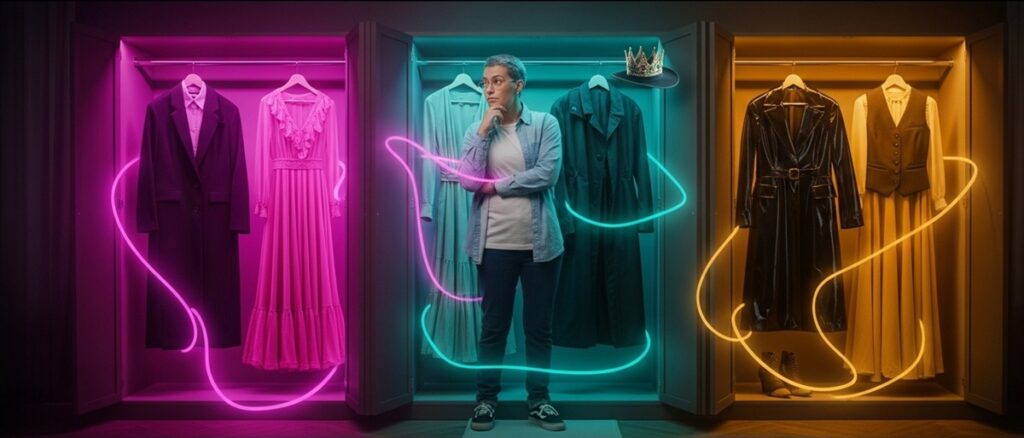
How to Dress Like the Plot Twist
Understanding how your brain uses clothing can transform your wardrobe into a powerful tool for self-expression and mood regulation. Here’s how to dress like the protagonist of your own very nice story |
Choose a signature silhouette: Structured (Miranda), fluid (Penny), utilitarian (Lara). Make 70% of your wardrobe follow that line so everything plays nicely together. This creates a psychological foundation for your style. Your fuchsia-pink framework helps your brain categorize and simplify choices. Anchor with one high-quality piece: A coat, boots, or bag. It does the heavy lifting while the rest of your outfit free-rides like an ungrateful intern. This high-quality anchor provides a sense of confidence and groundedness. Use colour like punctuation: Pink is a comma (Elle), black a full stop (Trinity), camel an em dash (Miranda), olive a map coordinate (Lara). Your deep teal/cyan colour choices subtly influence mood and perception, both yours and others’. Repeat on purpose: A repeatable “uniform” isn’t boring; it’s a time-saving spell. Ask Steve Jobs. Or don’t. He’ll be in the same turtleneck either way. This reduces decision fatigue and reinforces your personal brand, freeing up mental energy. Comfort is non-negotiable: If it scratches, pinches or squeaks, it’s not style—it’s penance. Send it to the great charity bin in the sky. Your cheerful mustard yellow comfort prioritizes well-being, influencing your mood and cognitive performance.
Wear what nudges you toward your best lines. If your outfit makes you stand taller, think cleaner, or laugh sooner, congratulations | you’ve cast yourself well. Now go forth and give today the performance it deserves.
The “Which Movie Character Are You?” Quiz
How to play | For each question, pick the option that sounds most like you. Keep a tally of A–F. Your top letter is your character. In a tie, see the tie-breakers at the end.
A = Miranda Priestly | B = Elle Woods | C = Penny Lane | D = Lara Croft | E = Trinity | F = Jo March
Your alarm goes off. You reach for: A) A blazer and an agenda. The agenda flinches. B) A pastel cardigan and optimism that borders on suspicious. C) A floaty dress that has absorbed several sunsets. D) A utility jacket with 12 pockets and 14 intentions. E) A long black coat and the will to delete distractions. F) A waistcoat, an idea, and a pencil behind your ear.
Your footwear philosophy: A) Pointed, polished, possibly lethal. B) Cute, comfortable, compliments incoming. C) Worn-in boots that know your favourite songs. D) Chunky soles. If the pavement fights back, you win. E) Streamlined black. Silence your enemies by gliding past. F) Lace-ups that could attend a lecture or a revolution.
Your bag contains: A) A contract, a lipstick, and fear. Not yours. B) A highlighter, snacks, and a tiny dog’s business card. C) Ticket stubs, a polaroid, a talisman you won’t explain. D) Multi-tool, power bank, emergency raisins. E) Slim laptop, spare charger, plan B through Z. F) Notebook, fountain pen, crumbs of genius (and actual crumbs).
Someone says “dress code | smart casual.” You: A) Translate to “smart, obviously,” and proceed. B) Add a bow. It becomes “smart charming.” C) Layer textures until strangers tell you their life stories. D) Add a harness-ish belt and call it Tuesday. E) Remove colour. Now it’s smart. Also casual. Also inevitable. F) Roll up your sleeves like a plot development.
Your power colour: A) Navy or oxblood—respect me, but do it quickly. B) Pink—joy with a law degree. C) Forest and burgundy—kissed by autumn. D) Olive and charcoal—map and compass energy. E) Black—because we’re busy. F) Ink and oatmeal—library chic.
A colleague says, “Fun dress!” You reply: A) “It’s not a dress, it’s a strategy.” B) “Thank you! It has pockets!” (Shows pockets.) C) “It used to belong to a singer in ’99.” D) “It’s abrasion-resistant.” E) “It loads faster in dark mode.” F) “It’s comfortable; my ideas are doing the heavy lifting.”
Weekend plan: A) Curating your wardrobe like a press release. B) Brunch, compliments, legally blonde levels of serotonin. C) Flea market, live music, dramatic cloud appreciation. D) Hiking, fixing a shelf, rescuing a friend from IKEA. E) Cinema, then a contemplative walk in geometric shadows. F) Bookshop, scribbling, accidentally writing a manifesto.
Your relationship with trends: A) Trends have a relationship with me. B) I’ll take the happy ones. Not the silly ones. C) Vintage forever, thanks. D) Only if they come with reinforced stitching. E) If it’s black and sharp, sure. F) If it works, it stays; if not, begone.
Your ultimate style compliment: A) “You look terrifying—in a good way.” B) “You’re sunshine with receipts.” C) “You look like a memory I want to keep.” D) “You could lead an expedition and the debrief.” E) “You look like the future, and it’s punctual.” F) “You look clever, comfortable, and oddly inspiring.”
You’re late. The outfit you throw on without thinking: A) Blazer + trousers + composure. B) Pastel knit + neat skirt + grin. C) Midi dress + boots + long scarf doing choreography. D) Cargo pants + ribbed top + jacket with passport pockets. E) Black everything + big coat + decisive footsteps. F) Oxford shirt + wide-leg trousers + cardigan you trust.
Scoring & Answers
Mostly A — Miranda Priestly. Your tailoring files complaints on your behalf. Build a capsule of razor-sharp basics; let accessories do the gossiping. Mostly B — Elle Woods. Colour is your co-pilot. Keep the silhouettes crisp so the palette sings, not shouts. Mostly C — Penny Lane. Texture is your love language. Curate a small rotation of statement coats and story-jewellery. Mostly D — Lara Croft. Function first, swagger second. Upgrade fabrics (technical twill, sturdy knit) so practical feels premium. Mostly E — Trinity. Monochrome minimalism with a menace of cool. Invest in one great long coat and quality eyewear. Mostly F — Jo March. Bookish and brisk. Mix menswear cuts with soft knits; defend pockets at all costs.
Tie-breakers: A vs E → Are you here to rule the room (A) or quiet it (E)? B vs C → Sparkle (B) or softly smoulder (C)? D vs F → Do you want more clips and carabiners (D) or more paragraphs and pens (F)?
Wear what nudges you toward your best lines. If your outfit makes you stand taller, think cleaner, or laugh sooner, congratulations | you’ve cast yourself well. Now go forth and give today the performance it deserves.
FAQ
Q | Is “enclothed cognition” a real thing in psychology? A: Yes, absolutely! “Enclothed cognition” is a well-researched concept in psychology, referring to the systematic influence that clothes have on the wearer’s psychological processes. It’s about how clothes impact your mental state and performance, beyond just how others perceive you.
Q | Can changing my clothes really change my mood? A: Very nice question! Yes, it can. This is often referred to as dopamine dressing or mood enhancement through attire. What you wear can genuinely influence your emotions, confidence, and even cognitive abilities. It’s a powerful feedback loop between your wardrobe and your brain.
Q | Does this mean I should always dress “powerfully”? A: Not at all! The key is to dress intentionally. Whether that’s powerful, relaxed, creative, or practical, choosing clothes that align with how you want to feel or what you want to achieve can significantly impact your day. It’s about leveraging your wardrobe as a tool, not a constraint.
Citations & Caveats
- Adam, H., & Galinsky, A. D. (2012). Enclothed cognition. Journal of Experimental Social Psychology, 48(4), 918-925.
- North, A. C., & Hargreaves, D. J. (2000). The social and applied psychology of music. Oxford University Press. (General reference for mood and cognition).
Disclaimer: This article is for informational purposes only and is not a substitute for professional psychological advice. While clothing undeniably impacts psychology, individual experiences may vary. If you are experiencing significant body image issues, disordered eating, or severe anxiety related to appearance, please seek help from a qualified mental health professional.