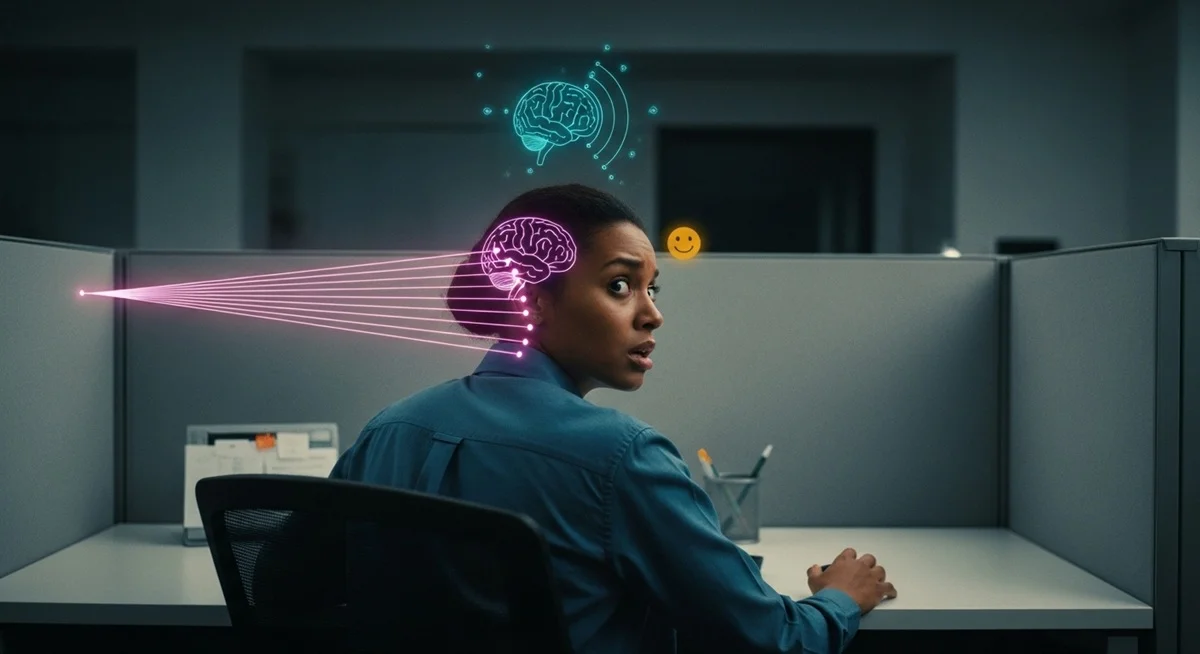
Scopaesthesia is your brain’s default habit of generating a full, convincing sensation of being watched from nothing more than an ambiguous shadow, a stray reflection, or a rustle of sound. The ‘I Feel Like I’m Being Watched!’ Brain runs this alarm with total conviction, even in an empty room. The very nice fix is the Cue Audit, a short, deliberate scan that tells the real cue apart from the imagined one.
Psychology explains this through: a hypersensitive gaze-detection system, built for spotting predators and rivals, that treats a shadow, a reflection, or a faint sound as strong enough evidence to generate the full feeling of an unseen observer.
The shadow was real. The watcher wasn’t.
Madness Meter: 👁️👁️👁️ The Empty Room Verdict (In controlled tests where every visual and auditory cue was removed, people’s guesses about whether they were being watched landed at almost exactly the rate a coin flip would.)
Most people assume the feeling means something, or someone, is actually there. Controlled research says otherwise. Once every possible cue, peripheral motion, reflection, sound, is removed from the test, guesses about being watched land right at chance, no better than guessing blind.
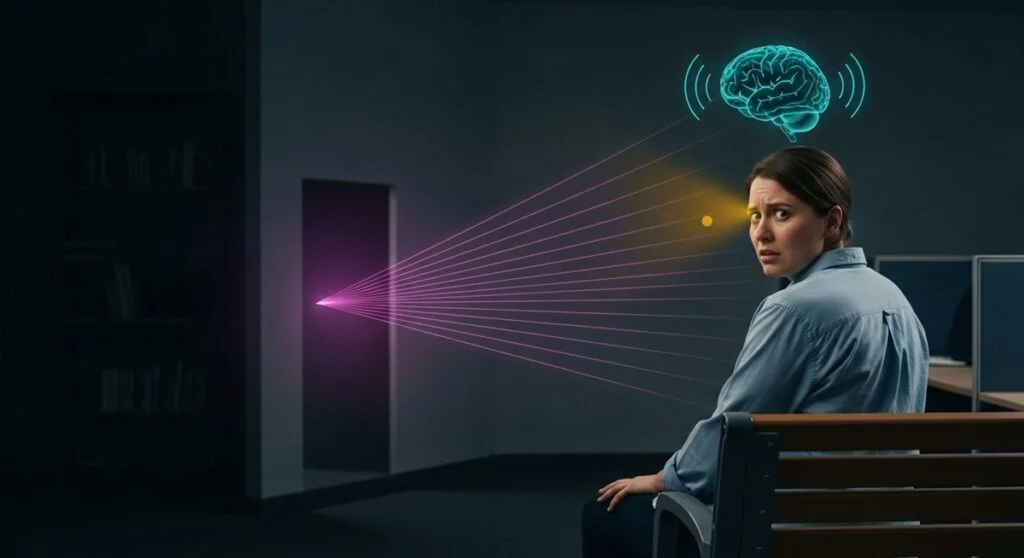
This creates The ‘I Feel Like I’m Being Watched!’ Brain, a mind that treats ambiguous sensory noise as strong enough evidence to generate the full, convincing feeling of an unseen observer, whether or not anyone is actually there.
S³ – Story • Stakes • Surprise
Story | The Unseen Staring Test
The Study: psychologists John Colwell, Susanne Schröder, and Deborah Sladen ran a controlled test of the claim that people can feel it when someone behind them is staring. The claim itself is old. Psychologist Edward Titchener investigated it back in 1898 using uncontrolled classroom demonstrations, and it had circulated as folk wisdom long before that. Colwell’s team finally tested it properly, seating participants facing away from a watcher connected only by closed-circuit camera, with every possible physical cue, reflections, sounds, air currents, engineered out of the setup.
The Result: across repeated trials, participants guessed whether they were being stared at with an accuracy statistically indistinguishable from chance. Confidence in the feeling didn’t line up with accuracy either. People who felt certain were wrong just as often as people who guessed.
The Mechanism: humans also have a well-documented reflex for tracking gaze itself, attention snaps toward a pair of eyes, real or depicted, faster and more automatically than toward almost anything else in a scene. Strip away the actual eyes and leave only ambiguous motion or shadow, and that same reflex still fires, manufacturing the sensation from a cue that was never actually a gaze at all.
Stakes | What the ‘I Feel Like I’m Being Watched!’ Brain Costs
A gaze-detector that fires on ambiguous cues has real costs:
The Wasted Alarm. Every false “someone’s there” spike triggers the same stress response as a genuine threat, elevated heart rate included, for a threat that was never in the room. Run often enough, that’s a lot of adrenaline spent on nothing.
The Hypervigilance Loop. A brain already running anxious sets this whole detection system more sensitive, which produces more false alarms, which raises baseline anxiety further. The phantom watcher and the anxiety feed each other rather than staying separate problems, and the loop can run for months without either side ever being traced back to the other.
The Crowded-Room Misfire. Dim light, reflective glass, and busy peripheral motion are exactly the conditions this system misreads most, so open-plan offices, parking garages, and CCTV-heavy spaces produce far more phantom-watched moments, not because anything is actually different there, just because there’s more ambiguous visual noise available to misfire on.
Surprise | The Cue Audit
The fix isn’t convincing yourself the feeling is fake. It’s finding out what actually produced it.
The Cure: run the ‘Cue Audit’ the moment the sensation lands:
- Name the Spike. Notice the exact instant the feeling arrives and name it plainly, “gaze-detector just fired,” instead of jumping straight to a conclusion about who’s there.
- Run the Cue Audit. Consciously scan for the actual candidate cue: a moving shadow, a reflection, a draft, a distant sound. Most spikes trace back to one of these once you actually look.
- Test the Alarm. If a calm look around turns up no one, treat that as real data. The detection system fired on ambiguous input, not an actual observer, and the alarm can stand down.
- Log the Pattern. Track which settings trigger it most, dim rooms, glass, crowds. Knowing your own triggers turns a spooky mystery into a predictable, manageable one.
A² – Apply • Amplify
The feeling was never the problem. Trusting it without checking was.
The Psychology Bits
- The Same Phantom Presence (Related): this exact feeling of being watched while alone, covered from a different angle in The ‘Ghost in the Corner’ Brain.
- The Broader Sixth Sense (Related): scopaesthesia’s closest cousin, a strong internal signal with no clear external cause, covered in The ‘I Just Had a Feeling!’ Brain.
Applying Gaze-Detection Architecture
Adopt these rules to keep the alarm honest:
- The Cue-First Rule. Before labeling a spike “someone’s there,” name the specific ambiguous input it most likely came from.
- The Environment Check. Dim light, reflective glass, and busy background motion are the conditions that trigger the most false alarms, so expect more of them there, not evidence something’s actually different.
- The Anxiety Link. Since general anxiety turns up the sensitivity of this whole system, “maybe I’m just wound up right now” is usually the more accurate read than “someone is definitely here.”
FAQ
Q | Does this mean the feeling isn’t real? A | The sensation itself is completely real, generated by real brain activity in a real detection system. What isn’t necessarily real is the observer your brain is convinced is there.
Q | Why does it happen more in some places than others? A | Dim lighting, reflective surfaces, and ambiguous peripheral motion are the conditions this system misreads most often, which is why certain rooms produce the feeling far more reliably than others.
Q | Could it ever be a genuine detection, like someone actually behind me? A | Sometimes there is a real, subtle cue your conscious mind hasn’t registered yet, a sound, a reflection, a shift in light, that your peripheral senses picked up before your awareness caught up. That’s a different case from a pure phantom alarm, and the Cue Audit is exactly how you tell which one actually happened.
Citations & Caveats
- Source 1: Colwell, J., Schröder, S., & Sladen, D. (2000). The Ability to Detect Unseen Staring: A Literature Review and Empirical Tests. British Journal of Psychology. (The controlled staring-detection test behind this piece’s Story.)
- Source 2: Friesen, C.K., & Kingstone, A. (1998). The Eyes Have It! Reflexive Orienting Is Triggered by Nonpredictive Gaze. Psychonomic Bulletin & Review. (The gaze-cueing reflex behind the Mechanism.)
Disclaimer: This article discusses scopaesthesia as documented in perception research, not a claim that every instance of feeling watched is imaginary. Real cues sometimes really are there. The point is checking before trusting the alarm completely.
Part of this site’s ongoing look at the brain’s stranger sensory habits. For the same phantom-presence feeling from a different angle, see The ‘Ghost in the Corner’ Brain. For the broader sixth-sense feeling this one belongs to, see The ‘I Just Had a Feeling!’ Brain.
// Protocol · Next Transmission
The glitch is the signal. — Psyness Protocol