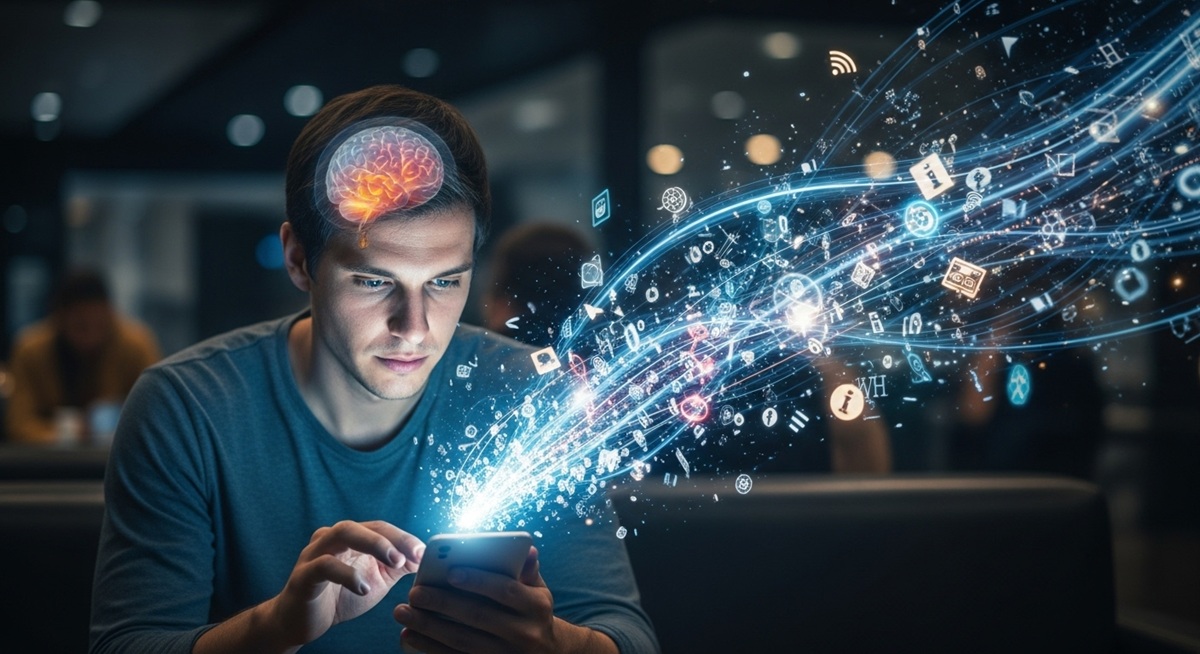
You’re having a debate with a friend about a historical fact, or trying to remember an actor’s name, or even just wondering how to tie a specific knot. Instead of racking your magnificent, weird brain for the answer, your hand instinctively reaches for your phone. “No worries, I’ll just Google it!” you declare. The answer appears instantly, satisfying your curiosity, but leaving your internal memory untouched. Your brain is convinced that external databases are the superior storage solution, making it a master of outsourcing its own recall. “Why remember when Google remembers for me? Very nice, my brain is very efficient at delegating!”
Welcome, fellow traveler, to the delightfully unhinged, universally experienced realm of Cognitive Offloading and the Google Effect (the ‘I’ll Just Google It’ Brain). It’s the glorious absurdity of your mind’s tendency to rely on external tools (like search engines, smartphones, and even other people) to store and retrieve information, rather than committing it to internal memory. Is it laziness? A peculiar form of digital dependence? Or is your beautiful brain simply doing its very nice, very efficient (though sometimes concerning) job of adapting to a world where information is always at its fingertips? At Psyness.com, we take a “very nice!” look at this pervasive mental quirk, proving that understanding why you outsource your memory doesn’t have to be boring – it can be a riot.
Your Brain’s External Hard Drive | The Outsourcing Strategy
Why does your mind so readily delegate its memory functions to external devices, even for information it could potentially store internally? It’s a fascinating testament to your magnificent brain’s drive for efficiency and its adaptability to new technological landscapes.
The Architect | The Least Effort Principle
Your brain, bless its tirelessly efficient heart, is always looking for the path of least resistance. If information is readily and reliably available externally, why expend the precious cognitive energy to store and retrieve it internally?
- Cognitive Offloading: This is the core mechanism. It’s the practice of relying on external aids (like notes, calendars, calculators, or search engines) to reduce the cognitive load on your own brain. In the digital age, this has become incredibly prevalent. Your brain recognizes that the internet is a vast, instantly accessible memory bank. “Why put in my brain when internet has it? Very nice, internet is very big brain for me!”
- The Google Effect (Digital Amnesia): Research shows that people are less likely to remember information if they know it can be easily found online. Our brains prioritize remembering where to find information (e.g., “I can Google that”) rather than the information itself. This leads to a form of “digital amnesia” for specific facts.
- Reduced Effort for Retrieval: Retrieving information from your own long-term memory can be effortful. Typing a query into a search engine and getting an instant answer often feels much quicker and easier, reinforcing the habit of external reliance.
- Increased Information Access: The sheer volume of information available online makes it impractical, if not impossible, for any single brain to store it all. Cognitive offloading allows us to access a much wider range of knowledge than ever before.
- Focus on Higher-Order Thinking: By offloading factual recall, your brain theoretically frees up resources for higher-order cognitive processes like critical thinking, problem-solving, creativity, and synthesis. The idea is that you don’t need to remember what to think, but how to think.
- The Illusion of Knowing: Constantly accessing information online can create an “illusion of knowing,” where you feel knowledgeable because you can easily find information, even if you don’t actually retain it.
The paradox? While cognitive offloading offers incredible access to knowledge and can free up mental bandwidth for complex tasks, an over-reliance on it might diminish our internal memory capacity for certain types of information, potentially impacting deep learning, critical thinking, and even our sense of self. Your brain’s “external hard drive” is magnificent, but gloriously unhinged in its digital dependence.
Pop Culture’s Smart Device Dependence | Our Shared Digital Brains
From characters in movies who are constantly looking up information on their devices, to comedic sketches about the inability to remember anything without Google, to the widespread use of voice assistants for every query, pop culture constantly reflects our universal reliance on external memory tools. We see the convenience, and sometimes the humorous helplessness, of our digitally augmented minds.

The glorious absurdity? We’ve built tools so powerful that our brains are happily letting them do the heavy lifting of remembering, turning us into walking, talking interfaces to the internet. It’s a shared, delightful madness where our personal knowledge is increasingly outsourced. Your inner Borat might ask a question and declare, “My brain does not know! But my phone knows! Very nice, my phone is very smart brain!”
Finding Your Inner Encyclopedia (Very Nice! And Truly Empowering!)
Understanding that your brain’s ‘I’ll Just Google It’ tendency is a natural, powerful adaptation to the digital age is the first step to liberation. It’s not about abandoning technology; it’s about learning to work with your magnificent, weird brain to balance external reliance with internal retention, fostering both access and deep understanding.
Here’s how to nudge your brain towards more intentional, “very nice!” memory building:
- Acknowledge the Impulse, Then Pause: When you feel the immediate urge to Google something, pause. “My brain wants to Google! Very nice, but maybe I know it?” Give your internal memory a chance to retrieve the information first.
- Practice “Active Recall”: Instead of just looking up an answer, try to actively retrieve it from your memory first. If you can’t, then look it up. After looking it up, try to explain it in your own words or write it down. This strengthens the neural pathways.
- Focus on Understanding, Not Just Information: When you do Google something, don’t just read the answer and move on. Try to understand the context and implications of the information. Connect it to what you already know. This fosters deeper learning and better retention.
- Limit “Lookup” for Key Information: For information that is truly important for your work, relationships, or personal well-being, make a conscious effort to commit it to memory rather than relying solely on external tools.
- Use Technology Intentionally: Recognize that technology is a tool. Use it to enhance your thinking and memory, not replace it. For example, use note-taking apps to organize thoughts, but still engage in active learning.
- Engage in Deep Reading and Learning: Regularly engage with content that requires sustained attention and internal processing, rather than just quick scans. This strengthens your brain’s capacity for deep thought and memory.
- Embrace the “Struggle”: Allow your brain to struggle a bit to retrieve information. That struggle is often what strengthens the memory trace. Don’t immediately give in to the urge to outsource.
The ‘I’ll Just Google It’ Brain is a truly special window into our complex psychology, a reminder that our minds, while magnificent, are also prone to delightful digital delegation. Knowing this doesn’t make you less intelligent; it makes you self-aware, wonderfully weird, and very nice! Embrace your inner librarian, understand your brain’s efficiency drive, and prove that you can build a powerful internal encyclopedia, even in the age of instant answers.
// Protocol · Next Transmission
The glitch is the signal. — Psyness Protocol