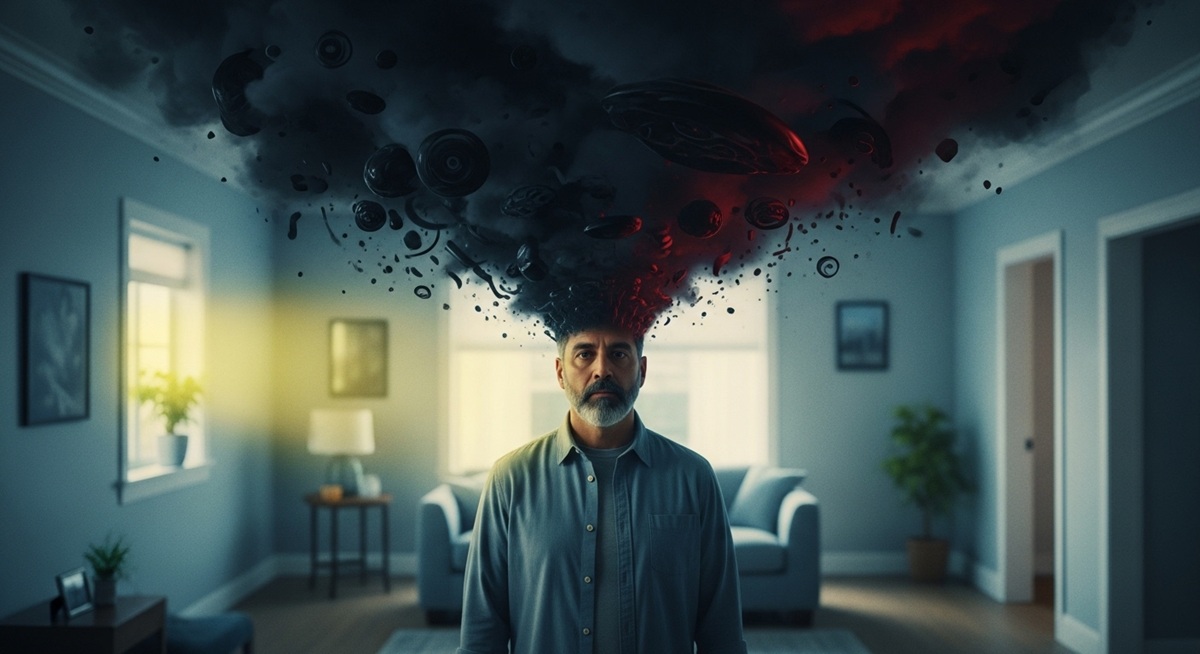
Negativity bias is the mind’s habit of giving bad events more weight, attention, and memory space than good ones of the same size. You receive five warm compliments and one slightly critical comment, and by midnight only the critical one is still playing. The vacation was wonderful, yet the travel delay is the part you retell.
Psychology explains this through: negativity bias, the finding that negative events, emotions, and information tend to have a greater impact on how we think and feel than positive ones.
A large review of the research concluded that bad is stronger than good across a broad range of psychological phenomena, with few exceptions.
Madness Meter: 🧠🧠🧠 The Storm Filter (Your brain lets sunny moments drift past and catches every cloud.)
It is the memory-sized cousin of The Inner Critic’s Stand-Up Routine. That one is about the voice that replays your flaws. This one explains why the replay has so much material to work with.
This creates the Storm Filter, the way negativity bias sorts your day so the one dark cloud outlasts the sky full of sun.
S³ – Story • Stakes • Surprise
Story | Bad Is Stronger Than Good
The Setup: Baumeister and colleagues reviewed evidence from many areas of psychology, including close relationships, emotions, learning, and how we form impressions of other people.
The Twist: In area after area, bad events had stronger effects than good events of comparable size. Bad emotions, bad parents, and bad feedback tended to leave larger marks than their positive counterparts, and bad impressions formed faster and were harder to undo.
The Reading: This is the Storm Filter. Your mind is not broken for fixating on the critical comment. It is following a general pattern that shows up across much of human psychology.
The Pattern: Negativity bias grows stronger when you are tired, stressed, or already scanning for problems, which is why a rough week makes every cloud look darker.
Stakes | What the Storm Filter Costs
Letting negativity bias run the show can quietly cost you:
The Skewed Picture Cost. When bad moments weigh more, your memory of a month can feel worse than the month actually was.
The Energy Cost. Replaying one criticism for hours takes mental effort that could have gone to the compliments or the work.
The Impression Cost. Because bad first impressions form quickly and fade slowly, you can misjudge people and let your own mistakes loom larger than others notice.
The Free-Pass Cost. Calling it a very nice built-in safety feature can stop you from checking whether the threat is real or only loud.
Surprise | A Tilt, Not a Flaw
Here is the twist about negativity bias. Rozin and Royzman describe it as a general tendency in both animals and humans, made of several parts such as negative potency, steeper negative gradients, and negativity dominance, where one bad element can sour a mix of good ones. The popular story that it exists because our ancestors needed to notice danger is a plausible hypothesis, not a settled fact, so it is best held loosely. What matters for you is that the tilt is common, not a verdict on your personality. And a tilt can be balanced on purpose, because deliberate attention to the good is a skill you can practice, not a mood you must wait for.
The Cure: Rebalance the Storm Filter by adding weight to the good side:
- Name the Cloud and the Sky: When one bad moment grabs you, deliberately list two or three things from the same day that went fine.
- Write Down Three Blessings: Once a week, record a few things you are grateful for, which in one study raised positive mood more reliably than listing hassles.
- Savor on Purpose: When something good happens, stay with it for a few extra breaths and notice the details before moving on.
- Set a News Boundary: Pick fixed times to check headlines and feeds, so your day is not scheduled by whatever is most alarming.
A² – Apply • Amplify

The cloud is real, but it is not the whole sky.
The Psychology Bits
- Bad Is Stronger Across Domains: The 2001 review found stronger effects of bad than good in relationships, emotions, learning, and impression formation.
- Negativity Has Several Parts: Rozin and Royzman separate negative potency, steeper gradients, negativity dominance, and negative differentiation, all pointing toward heavier weighting of the bad.
- Gratitude Has Modest, Real Effects: Emmons and McCullough found that people who counted blessings reported heightened well-being on several, though not all, measures, with positive mood the most robust result.
- It’s a Specific Case of a Bigger Pattern: The way mood and importance shape what gets remembered is explored in The ‘Beginning & End’ Brain. That one is about which moments stand out in a sequence. This one is about why the unpleasant ones stand out most.
Applying the Negativity Bias Habit
Treat negativity bias as a weighting error to correct, not a truth to obey:
- Run a Two-Sided Recap: At the end of the day, write one thing that went wrong and at least two that went right, then compare their real sizes.
- Ask for the Evidence: When a bad thought feels huge, ask what the actual evidence is and whether you would call it huge if it happened to a friend.
- Pause Before Replaying: If you catch yourself rewinding a criticism, switch to a concrete task such as a short walk or a call to break the loop.
- Take Action on Real Problems: If the worry points to something fixable, write one next step, then let it rest.
FAQ
Q | Does negativity bias mean I am a pessimist? A | No. It is a common tendency that appears across people, not a measure of your personality or outlook.
Q | Why does one criticism outweigh many compliments? A | Research on negativity bias suggests bad events tend to carry more psychological weight than good events of similar size, so the criticism can feel bigger than it is.
Q | Is negativity bias an evolutionary survival instinct? A | It is a common hypothesis that noticing threats helped survival, but the evolutionary explanation is not settled, so treat it as plausible rather than proven.
Q | Does keeping a gratitude journal really help? A | In one well-known study, people who counted blessings reported better mood on several measures, with positive mood the most robust finding, though effects were not universal.
Q | Should I avoid the news altogether? A | Not necessarily. Staying informed matters, so many people find that fixed check-in times work better than constant exposure.
Q | When should I seek help? A | If negative thoughts stay intense for weeks, interfere with sleep or daily life, or come with persistent low mood or hopelessness, a qualified mental health professional can help.
Citations & Caveats
- Source 1: Baumeister, R. F., Bratslavsky, E., Finkenauer, C., & Vohs, K. D. (2001). Bad is stronger than good. Review of General Psychology, 5(4), 323-370.
- Source 2: Rozin, P., & Royzman, E. B. (2001). Negativity bias, negativity dominance, and contagion. Personality and Social Psychology Review, 5(4), 296-320.
- Source 3: Emmons, R. A., & McCullough, M. E. (2003). Counting blessings versus burdens | An experimental investigation of gratitude and subjective well-being in daily life. Journal of Personality and Social Psychology, 84(2), 377-389.
Disclaimer: This article is for informational purposes only and is not a substitute for professional psychological advice. Noticing the bad more than the good is a common human tendency, not a diagnosis. If persistent negative thoughts are affecting your well-being or daily life, please speak with a qualified mental health professional.
// Protocol · Next Transmission
The glitch is the signal. — Psyness Protocol