You’re painting, coding, playing music, or perhaps just completely absorbed in a challenging puzzle. The world outside fades away. Your phone buzzes, but you don’t hear it. Hours pass like minutes, and when you finally look up, you’re surprised by how much time has elapsed, and how much you’ve accomplished. You feel energized, focused, and profoundly satisfied, as if you were merely a conduit for the task itself. Your magnificent, weird brain has entered a magical state where self-consciousness vanishes, distractions fade, and time seems to warp or disappear entirely. You weren’t just doing the thing; you were the thing. “My brain, it is very busy! Time, it is very fast! Very nice, I feel very good!
Welcome, fellow traveler, to the delightfully unhinged, universally experienced realm of the ‘Lost in the Moment’ Brain, a potent manifestation of the Psychology of Flow. Coined by psychologist Mihaly Csikszentmihalyi, “Flow” is that optimal state of consciousness where you are completely immersed in an activity, feeling energized focus, full involvement, and enjoyment in the process. It’s the glorious absurdity of your mind achieving peak performance and profound engagement, where the challenge perfectly matches your skill, and everything else melts away. Is it just intense concentration? A peculiar form of meditation? Or is your beautiful brain simply doing its very nice, very efficient (though sometimes profoundly transformative) job of finding its sweet spot for optimal experience and deep satisfaction? At Psyness.com, we take a “very nice!” look at this pervasive mental quirk, proving that understanding how to find your flow doesn’t have to be boring – it can be a riot.
Your Brain’s Optimal Zone | The Effortless Engagement Engine
Why does your mind occasionally slip into this magical state where effort feels effortless, and time becomes irrelevant? It’s a fascinating testament to your magnificent brain’s capacity for deep engagement, its love for mastery, and its intricate dance between challenge and skill.
The Architect | The Challenge-Skill Balancer
Your brain, bless its tirelessly seeking heart, thrives on meaningful engagement. The Flow state isn’t about relaxation or mindless activity; it’s about being fully alive and fully utilized. It occurs when specific conditions align, creating a perfect feedback loop that keeps your attention locked and your abilities stretched just enough.
- The Challenge-Skill Balance: This is the core mechanism. Flow happens when the challenge of an activity perfectly matches your skill level. If the challenge is too high, you get anxious. If it’s too low, you get bored. But when they align, your brain finds its sweet spot, and the activity becomes intrinsically rewarding. “This task, it is very hard, but I am very good! My brain says ‘perfect match!’ Very nice, I feel very strong!”
- Clear Goals & Immediate Feedback: In a Flow state, you know exactly what you’re trying to achieve, and you get immediate, clear feedback on your progress. This constant feedback loop keeps you adjusted and engaged, reinforcing the behavior.
- Concentration & Focus: Distractions fade away. Your attention is so completely absorbed by the task that there’s no mental space left for irrelevant thoughts or worries. Your brain’s attentional resources are fully dedicated.
- Loss of Self-Consciousness: In Flow, your ego temporarily dissolves. You stop thinking about yourself, your worries, or how you’re perceived. You become one with the activity. This is profoundly liberating.
- Transformation of Time: Time perception gets warped. Hours can feel like minutes, or vice versa, depending on the intensity of the experience. Your brain is so engrossed that its internal clock becomes irrelevant.
- Autotelic Experience: Flow activities are “autotelic,” meaning they are intrinsically rewarding. You do them for the sheer joy of the activity itself, not for an external reward. The process is the reward.
- Dopamine & Norepinephrine: Neurochemically, Flow states are associated with a surge of neurotransmitters like dopamine (for motivation and reward) and norepinephrine (for focus and arousal), creating a highly pleasurable and energized experience.
The paradox? Your brain’s capacity for profound focus and effortless performance, while leading to peak experiences, can be elusive and requires specific conditions to unlock. Your brain’s “optimal zone” is magnificent, but gloriously unhinged in its effortless engagement.
Pop Culture’s Peak Performers | Our Shared Pursuit of Greatness
From athletes describing being “in the zone,” to artists losing themselves in their creations, to musicians feeling a complete connection with their instrument, to video game players achieving impossible feats with fluid grace, pop culture constantly reflects and often romanticizes the Flow state. We see the allure of effortless mastery and the profound satisfaction of being completely absorbed in a passion.
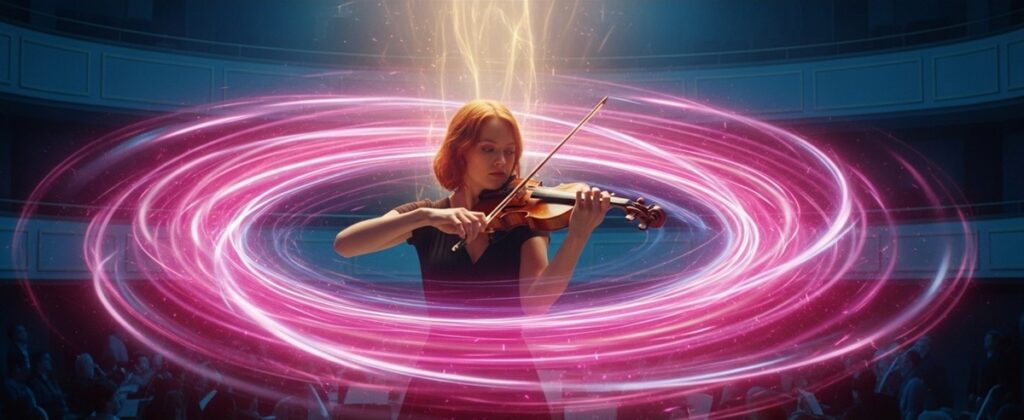
The glorious absurdity? We spend so much time seeking external validation, yet our brains find their deepest joy and most profound productivity when they’re completely lost in an activity, forgetting themselves entirely. It’s a shared, delightful madness where true happiness often lies in forgetting to be happy. Your inner Borat might be in Flow and declare, “My brain is very busy with task! Time, it is very fast! Very nice, I am very good at this!”
How to Find Your Flow (Very Nice! And Truly Liberating!)
Understanding that your brain’s ‘Lost in the Moment!’ tendency (Flow) is a natural, powerful cognitive state is the first step to liberation. It’s not about finding a magic trick; it’s about learning to work with your magnificent, weird brain to intentionally create the conditions that allow you to slip into this optimal zone, unlocking peak performance and profound satisfaction.
Here’s how to nudge your brain towards more frequent, “very nice!” Flow experiences:
- Identify Your “Flow Triggers”: What activities have you done in the past where time seemed to disappear? What hobbies, tasks, or challenges genuinely captivate you? Start there. “What makes my brain very happy and very busy? Very nice, I will do more of that!”
- Match Challenge to Skill: Choose tasks that are slightly beyond your current skill level – enough to be challenging, but not so much that they’re overwhelming. This is the sweet spot. If it’s too easy, increase the difficulty; too hard, break it down.
- Set Clear Goals & Get Immediate Feedback: Before starting, know exactly what you want to achieve. As you work, pay attention to the small victories and immediate results that tell you you’re on the right track.
- Eliminate Distractions: Create an environment free from interruptions. Turn off notifications, put your phone away, close unnecessary tabs. Give your brain the space to focus.
- Practice Deep Concentration: Start with short bursts of focused work (e.g., 25 minutes using the Pomodoro Technique). Gradually extend these periods as your concentration improves.
- Embrace the Process, Not Just the Outcome: Shift your focus from the end result to the enjoyment of the activity itself. Flow is about the journey, not just the destination.
- Know Your Energy Levels: Engage in Flow-inducing activities when you are well-rested and have sufficient mental energy. Trying to force Flow when exhausted is difficult.
- Reflect on Your Flow Experiences: After a Flow session, take a moment to reflect on what worked. What were the conditions? How did you feel? This helps you replicate the experience.
The ‘Lost in the Moment!’ Brain is a truly special window into our complex psychology, a reminder that our minds, while magnificent, are also prone to delightful states of optimal engagement. Knowing this doesn’t make you a productivity robot; it makes you self-aware, wonderfully weird, and very nice! Embrace your inner master, understand your brain’s optimal zone, and prove that you can find your flow, transforming ordinary tasks into extraordinary experiences.